

As a boutique accounting practice, a great deal of our clients are small businesses. The majority of these are treated as Small Business Corporations (SBCs) from a tax perspective. The tax relief that this offers our clients can be quite substantial, provided it is being utilised effectively.
Companies are taxed at a flat rate of 28% (27% for years of assessment ending after 1 April 2023), whereas SBCs are taxed at more favourable rates on taxable income up to R550 000, as evidenced by the SBC tax rates below:
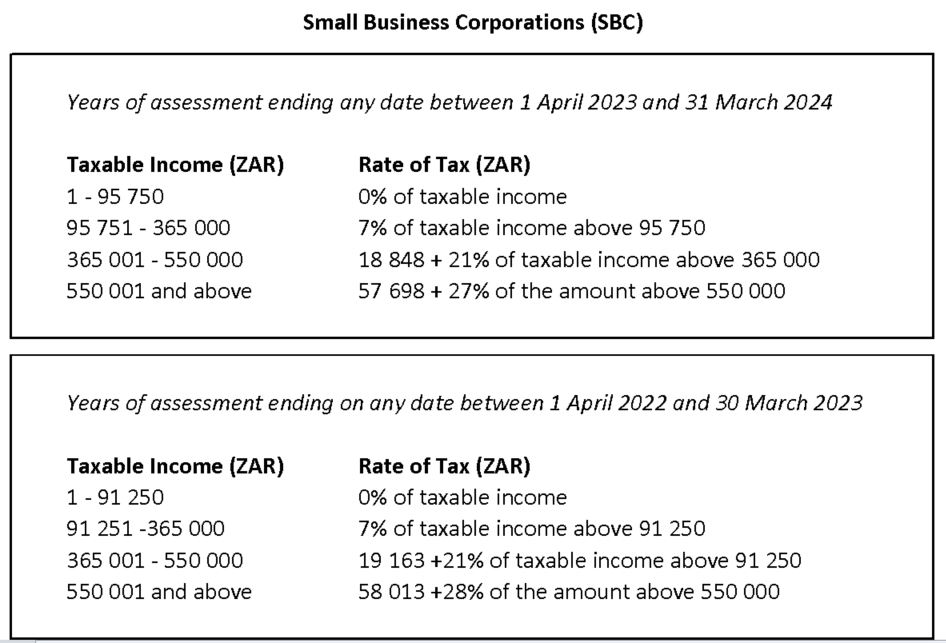
A secondary benefit that SBCs qualify for is an accelerated depreciation allowance on plant and machinery. Simply put, manufacturing assets qualify for a 100% write-down in the year of assessment in which the asset was brought into use, whereas non-manufacturing assets can be written down at 50% in the first year, 30% in the second year and 20% in the third year (50:30:20). Alternatively, SBCs have the option to claim the general wear and tear allowance, however the accelerated depreciation allowance is generally more favourable from a cash flow perspective.
To qualify for the SBC tax relief, a company must meet the following requirements:
- The business must be a resident in South Africa.
- The business must be a close corporation, company or co-operative.
- The business must have a gross income of less than R20 million in the year of assessment.
- Shareholders of the business must be natural persons.
- No shareholders should hold any shares or have any interest in the equity of any other company, other than a few exceptions as stipulated in the Income Tax Act (listed companies, collective investment schemes, body corporates, etc.).
- No more than 20% of the total receipts and accruals of the SBC may collectively consist of “investment income” and income from the rendering of a “personal service” as defined in the Income Tax Act.
- The business must not be classified as a “personal service provider” as defined in the Fourth Schedule of the Income Tax Act.
“Investment income” broadly means any income in the form of dividends, royalties, rental derived in respect of immovable property, and interest and proceeds from investing or trading in financial instruments, marketable securities or immovable property.
A “personal service” means any service in the field of accounting, actuarial science, architecture, auditing, broadcasting, consulting, draftmanship, education, engineering, financial service broking, health, information technology, journalism, law, management, real estate broking, research, sport, surveying, translation, valuation or veterinary science, if –
- That service is performed personally by any person who holds an interest in the business or by any person that is a connected person in relation to any person holding such an interest; and
- The business does not, throughout the year of assessment, employ three or more full-time employees (other than any employee who is a shareholder in the business, or who is a connected person in relation to a shareholder of the business), who are on a full-time basis engaged in the business of rendering that service.
From the above, there are a few implications, and we regularly advise our clients on the best way to structure their affairs so as to most effectively utilise the tax relief offered to small businesses.
Some of the common implications that we deal with are as follows:
- When considering registering a second company, due consideration needs to be given to forgoing the possible tax relief offered to SBCs. The business will no longer qualify as an SBC if the shareholder is also a shareholder in another company. For this reason, it may make sense to house a new business venture in the same company. Businesses with more than one shareholder should also ensure that all shareholders are aware of the implications for the business should they become shareholders in another entity.
- If a business owner qualifies as an SBC, and intends on purchasing rental property, it potentially makes more sense to hold the investment property in the individual’s personal capacity. If the investment property is brought into the SBC entity, the business owner will need to be careful to ensure that the income generated by the property does not exceed 20% of the business’ total income. The same applies to other forms of investment income.
- It may make financial sense for a small business that offers professional services to employ more than three full-time employees, provided the tax benefit exceeds the cost of the additional employee(s).
- A lot of professional advisories go to great lengths to punt the merits of trusts, often ignoring some of the pitfalls. A potential issue is that the shareholders have to be natural persons in order to qualify, so putting the shares into a trust is not only going to cost you more from an administration perspective, but you could also be losing out by not being able to benefit from the SBC tax relief.
- A small business owner that wants to register a separate investment/property company could establish a trust that would be the shareholder in this entity, thereby leaving the business owner untainted for purposes of qualifying for the SBC tax relief.
The potential tax relief offered to a qualifying SBC can be material, however needs to be considered as part of a greater tax strategy. At BR Whitaker & Co, we have been advising South Africans on their tax affairs for nine decades, and are well-equipped to assist in evaluating your business and tax requirements.
